
 Business/Economy
Nigeria faces fiscal transparency crisis amid revenue discrepancy allegations
Business/Economy
Nigeria faces fiscal transparency crisis amid revenue discrepancy allegations
Written By: Editor
19 Dec 2025 02:14 PM
In a scathing critique, civic technology platform MonITNG has accused the Nigerian Federal Government of opacity in public finance management, highlighting conflicting revenue figures that have sparked widespread concern over budget credibility and accountability.
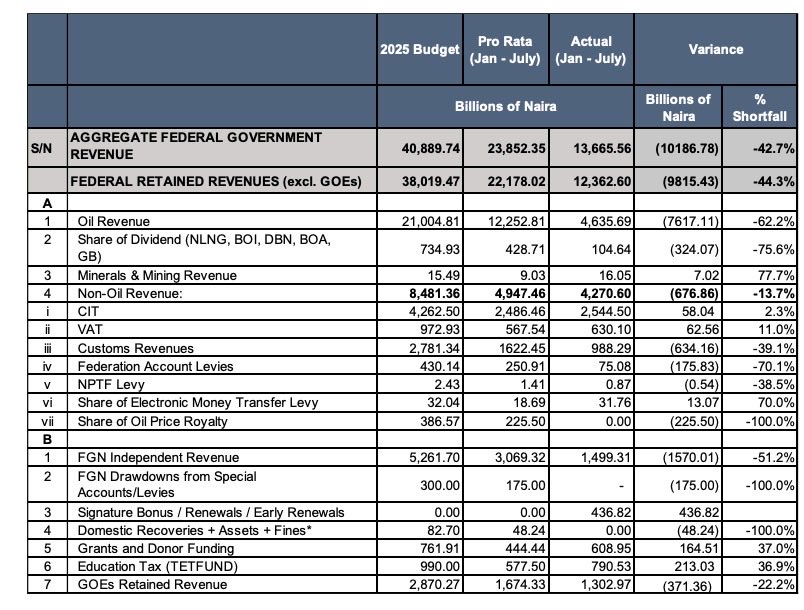
The critique posted on X (formerly Twitter) which includes a detailed revenue breakdown table from the Medium-Term Expenditure Framework (MTEF), comes amid broader reports of a massive revenue shortfall for 2025, with Finance Minister Wale Edun admitting the government is on track to collect only about ₦10.7 trillion against a projected ₦40.8 trillion.
The MonITNG post, shared on Friday on @monitng, points to data from the MTEF indicating that as of July 2025, the Federal Government had generated ₦13.6 trillion in aggregate revenue while spending ₦20.39 trillion in the same period, a deficit that raises questions about funding sources, including potential undisclosed borrowing.
"This lack of clarity matters because public finance decisions affect every Nigerian," the post states, calling for timely disclosure and reconciliation of figures.
It directly contrasts the MTEF data with Minister Edun's recent public statement that revenue stands at only ₦10.7 trillion "so far," a figure nearly ₦3 trillion lower than the July midpoint reported in official documents.
The accompanying table reveals significant shortfalls across key revenue streams for the first seven months of 2025:
Oil Revenue: Actual ₦4.636 trillion against a pro-rata target of ₦12.253 trillion, a 62.2% shortfall.
Non-Oil Revenue: Including Company Income Tax (CIT) at ₦2.545 trillion (actual) vs. ₦2.486 trillion (pro-rata), showing a modest 2.3% surplus, but offset by larger gaps elsewhere.
Customs Revenues: ₦0.988 trillion actual vs. ₦1.623 trillion pro-rata, down 39.1%.
Other Categories: Notable underperformance in Federation Account Levies (70.1% shortfall) and Share of Oil Price Royalty (100% shortfall).
Overall, aggregate revenue hit just 57.3% of the pro-rata target by July, equating to a ₦10.187 trillion variance.
This revelation builds on earlier concerns raised by BudgIT, a prominent civic organization, which on December 17 posted similar warnings about the government's projected year-end revenue of just ₦10.7 trillion, a staggering 73.8% miss on the ₦40.8 trillion target.
BudgIT attributed the gap to unrealistic budgeting, leading to unpaid contractors and stalled projects, and urged a shift toward "proper planning and real revenue."
Minister Edun's comments, made during a Senate committee session on the 2024-2026 MTEF, have fueled the controversy. He attributed the shortfall to underperforming oil and non-oil sectors, noting that the government borrowed ₦14.1 trillion in 2025 to bridge the gap.
However, no direct response from the Minister or the Finance Ministry to the specific MTEF discrepancy has been reported in recent statements.
Official sources present a mixed picture: A State House press release from September claimed total collections reached ₦20.59 trillion from January to August, driven by non-oil revenues, while monthly FAAC allocations, such as ₦1.703 trillion shared in January, suggest robust gross inflows.
This contrasts sharply with the Minister's year-end projection, potentially indicating differences between gross collections, federal retained revenues, and net figures.
Critics argue these inconsistencies erode public trust, especially as Nigerians grapple with inflation, rising costs, and debt servicing that consumes a growing share of the budget.
The critique posted on X (formerly Twitter) which includes a detailed revenue breakdown table from the Medium-Term Expenditure Framework (MTEF), comes amid broader reports of a massive revenue shortfall for 2025, with Finance Minister Wale Edun admitting the government is on track to collect only about ₦10.7 trillion against a projected ₦40.8 trillion.
The MonITNG post, shared on Friday on @monitng, points to data from the MTEF indicating that as of July 2025, the Federal Government had generated ₦13.6 trillion in aggregate revenue while spending ₦20.39 trillion in the same period, a deficit that raises questions about funding sources, including potential undisclosed borrowing.
"This lack of clarity matters because public finance decisions affect every Nigerian," the post states, calling for timely disclosure and reconciliation of figures.
It directly contrasts the MTEF data with Minister Edun's recent public statement that revenue stands at only ₦10.7 trillion "so far," a figure nearly ₦3 trillion lower than the July midpoint reported in official documents.
The accompanying table reveals significant shortfalls across key revenue streams for the first seven months of 2025:
Oil Revenue: Actual ₦4.636 trillion against a pro-rata target of ₦12.253 trillion, a 62.2% shortfall.
Non-Oil Revenue: Including Company Income Tax (CIT) at ₦2.545 trillion (actual) vs. ₦2.486 trillion (pro-rata), showing a modest 2.3% surplus, but offset by larger gaps elsewhere.
Customs Revenues: ₦0.988 trillion actual vs. ₦1.623 trillion pro-rata, down 39.1%.
Other Categories: Notable underperformance in Federation Account Levies (70.1% shortfall) and Share of Oil Price Royalty (100% shortfall).
Overall, aggregate revenue hit just 57.3% of the pro-rata target by July, equating to a ₦10.187 trillion variance.
This revelation builds on earlier concerns raised by BudgIT, a prominent civic organization, which on December 17 posted similar warnings about the government's projected year-end revenue of just ₦10.7 trillion, a staggering 73.8% miss on the ₦40.8 trillion target.
BudgIT attributed the gap to unrealistic budgeting, leading to unpaid contractors and stalled projects, and urged a shift toward "proper planning and real revenue."
Minister Edun's comments, made during a Senate committee session on the 2024-2026 MTEF, have fueled the controversy. He attributed the shortfall to underperforming oil and non-oil sectors, noting that the government borrowed ₦14.1 trillion in 2025 to bridge the gap.
However, no direct response from the Minister or the Finance Ministry to the specific MTEF discrepancy has been reported in recent statements.
Official sources present a mixed picture: A State House press release from September claimed total collections reached ₦20.59 trillion from January to August, driven by non-oil revenues, while monthly FAAC allocations, such as ₦1.703 trillion shared in January, suggest robust gross inflows.
This contrasts sharply with the Minister's year-end projection, potentially indicating differences between gross collections, federal retained revenues, and net figures.
Critics argue these inconsistencies erode public trust, especially as Nigerians grapple with inflation, rising costs, and debt servicing that consumes a growing share of the budget.
Comments